
Food & Drink History
Origins of the Negroni
Explore the documented origins and disputed stories behind the Negroni cocktail and its association with Florence.
By DrinkKnird · October 10, 2026 · 3 min read
In this section: Food & Drink History · batch calculator · Food & drink history
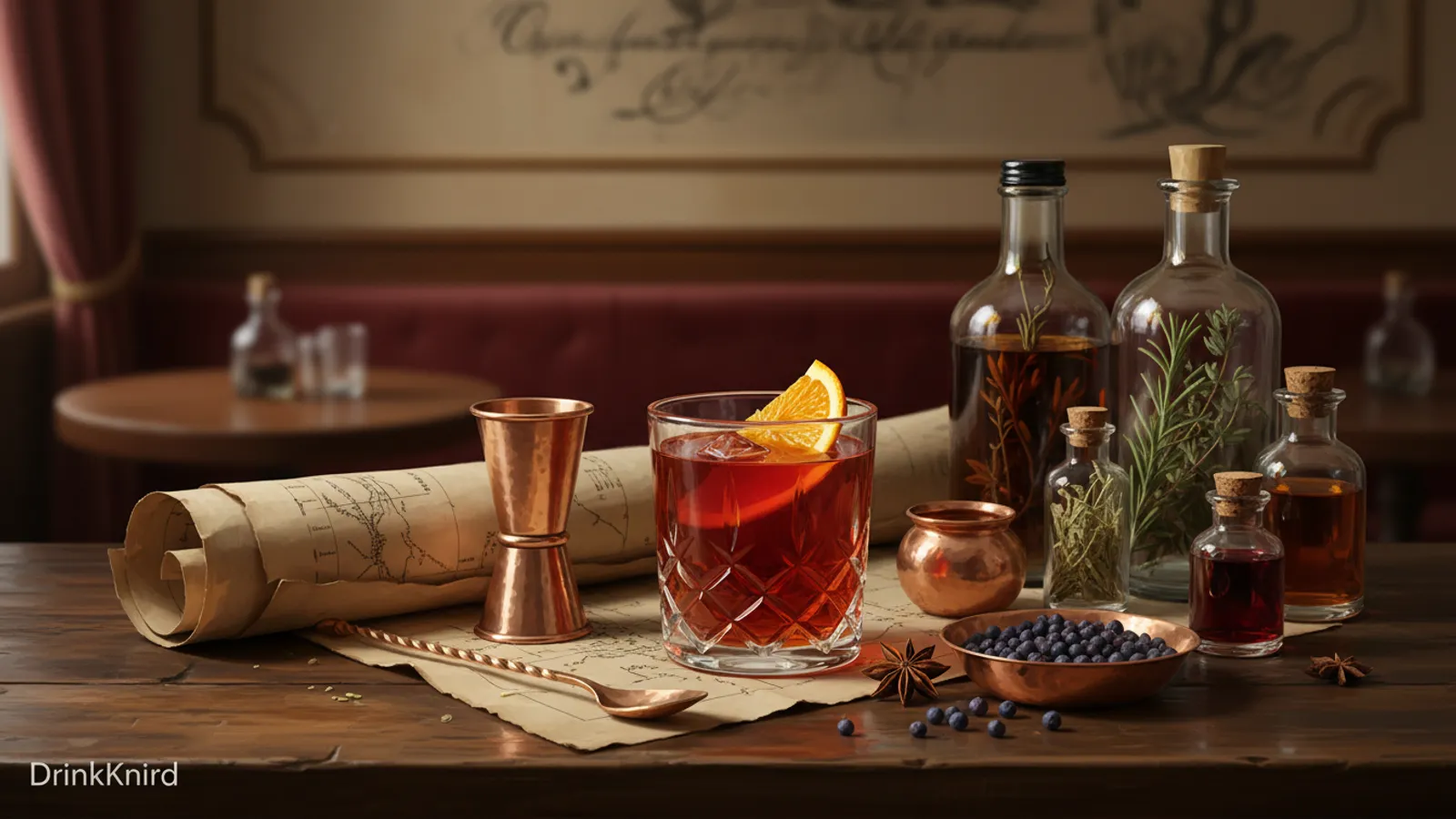
What it is
The Negroni is a cocktail traditionally made with equal parts gin, sweet vermouth, and Campari, garnished with a slice of orange. It is known for its distinctive bitter-sweet flavor profile and its vibrant red color. The drink is considered a classic aperitivo in Italian culture, often enjoyed before meals to stimulate the appetite.
Documented origin claims
The most widely circulated origin story credits Count Camillo Negroni, a wealthy Florentine, with inventing the cocktail around 1919. According to this account, Count Negroni asked a bartender at the Caffè Casoni (sometimes also linked to the Hotel Baglioni) in Florence to strengthen his usual Americano cocktail by replacing the soda water with gin. This modification resulted in the now-famous combination of gin, sweet vermouth, and Campari.
This narrative is supported by cocktail reference sources such as Encyclopaedia Britannica and Difford’s Guide, which treat the Count Negroni story as the standard origin, though not definitively proven by primary sources. The story has been popularized in cocktail literature and media, including coverage by the New York Times and Punch Drink, which also note that later printed recipes and bar practices helped solidify the Negroni’s formula and reputation.
However, some historians and enthusiasts question the completeness of this account, noting the absence of contemporary documentation from the 1910s or 1920s that explicitly records the cocktail’s invention or Count Negroni’s involvement. The story largely rests on oral tradition and retrospective attribution rather than archival proof.
Time, place, and why Florence is associated with it
Florence, Italy, is central to the Negroni’s origin story because the cocktail is said to have been created in one of its historic cafés during the early 20th century. The city’s vibrant café culture and aperitivo tradition provide a plausible setting for the drink’s emergence. The Caffè Casoni and Hotel Baglioni are often mentioned as the venues where the Negroni was first mixed.
Florence’s association with the Negroni is reinforced by local bartenders and historians, such as Luca Picchi of the Caffè Rivoire, who have studied and promoted the cocktail’s history through seminars and tastings. This connection has helped establish the Negroni as a symbol of Florentine and Italian aperitivo culture.
What remains uncertain or disputed
Despite the widespread acceptance of the Count Camillo Negroni story, the documentary record leaves several uncertainties:
- There is no surviving contemporaneous written record from the 1910s or 1920s confirming the exact moment or place of the cocktail’s invention.
- Alternative claims exist, such as a 1980 newspaper article attributing the drink’s invention to a Pascal Olivier in Saint Louis, Senegal, in the mid-19th century. This claim lacks broader corroboration and is not widely accepted in mainstream cocktail history.
- The precise identity and role of the bartender involved in the original creation are unclear, with some sources naming Fosco Scarselli at the Hotel Baglioni, but without definitive archival evidence.
- The exact recipe and proportions may have evolved over time, with modern variations differing from the original equal-parts formula.
These gaps highlight the limits of relying on oral tradition and retrospective storytelling in cocktail history, where myth and fact often intertwine.
How the tradition looks today
Today, the Negroni remains one of the most popular and iconic Italian cocktails worldwide. Its classic recipe—equal parts gin, sweet vermouth, and Campari, garnished with orange—is widely recognized and served in bars globally.
Florence continues to celebrate the Negroni as part of its cultural heritage, with bartenders and enthusiasts honoring its legacy through events, tastings, and educational seminars. The cocktail’s enduring appeal lies in its balance of bitter, sweet, and herbal flavors, making it a staple of aperitivo culture.
Modern bartenders sometimes experiment with variations, adjusting the proportions or substituting ingredients to suit contemporary palates, but the traditional Negroni remains the benchmark.
The Negroni’s story, while not fully documented in primary sources, exemplifies how cocktails can become entwined with place and personality, shaping cultural identity even amid historical uncertainties.
For more on the broader context of cocktail history, see History of food and beverage and explore related Cocktail recipes.
Sources
Selected references used for this guide. Prefer primary and government sources where available.
- Negroni — britannica.com
- Negroni cocktail — diffordsguide.com
- The Ultimate Guide to the Negroni — punchdrink.com
- The Negroni: A Study in Bitters — nytimes.com
- SHAKEN AND STIRRED; Dressing Italian - The New York Times — query.nytimes.com
- Campari Academy e la Storia del Negroni - Mixer Planet — web.archive.org
Keep reading
Food & Drink History
The History of Chicago Italian Beef
Discover the documented history and origins of Chicago's Italian beef sandwich, its ties to the city's culture, and what remains disputed.

Food & Drink History
The origin of the cocktail
Explore the early documented uses, 1806 definition, and disputed origins of the cocktail in American history.
Food & Drink History
The Art of Winter Food Storage: A Historical Journey
A short history of winter food storage—from drying and salting to refrigeration—and what traditional methods still teach home cooks.